
Calbright College
An employer experience through service design
Skills
Service Design
User Research
Personas
Journey Mapping
User Flows
Competitor Analysis
Tools
Figjam
Google Slides
Google Sheets
Duration
4 months
My Role
Experience Lead
Calbright College is the first free, fully-online community college in California providing skills-based education to adult learners. As a startup institution, Calbright needed a clear, intentional employer experience to connect students and alumni with meaningful career opportunities.
Who is Calbright College?
As the inaugural lead for employer relations, I identified a fragmented employer experience that limited Calbright College’s ability to build sustainable partnerships. I approached this as a service design problem, using research, comparative analysis, and stakeholder input to define employer needs and institutional constraints. These insights informed an end-to-end employer engagement framework with clear touchpoints, workflows, and success metrics. Within six months, the experience supported outreach to 280 employers, achieved a 10%+ response rate, converted over half into ongoing partners, and enabled scalable partner management through a cross-team HubSpot implementation.
Summary
Problem
Employer Problem
Employers lacked a clear and consistent way to learn about and engage with Calbright, leading to missed partnership opportunities and limited access to the college’s talent pool.
Internal Team Problem
Internal teams had no established process for working with employers, making outreach inconsistent and reducing the ability to build sustainable, long-term partnerships.
Business Problem
Without a clear employer engagement model, Calbright risked limiting career opportunities for learners and weakening its ability to build sustainable employer partnerships.
Together, these challenges highlighted the need for an intentionally-designed strategy that was a smooth, transparent experience for employers while creating scalable systems for internal teams.
Solution
Over four months, I led the creation of Calbright’s first employer relations strategy. My approach combined research, service design, and prototyping to ensure the final service was actionable, evidence-based, and scalable.
Translate insights into artifacts
Conduct research with employers and teammates
Prototype and implement
Develop four strategic pillars
Document as a comprehensive strategy
Research
To ground the strategy in real needs, I led a two-month research process focused on understanding employers’ goals, pain points, and motivations when engaging with colleges. I combined qualitative research with competitive analysis to ensure insights were both empathy-driven and evidence-based.
Data Collection
Employer Discovery Calls
I outreached, scheduled, and conducted calls with 12 employers to learn about their entry-level recruitment needs, perceptions of community colleges, and pain points in past partnerships.
These allowed me to capture valuable first-hand insights, including key opportunities and deal-breakers.
Competitor Analysis
I researched similar online institutions and established universities to identify best practices and opportunities to differentiate.
This analysis provided context and benchmarks, ensuring alignment to industry standards while identifying room for innovation.
Internal Team Interviews
I interviewed internal team members who work with external contacts to understand how they track interactions and manage relationships.
This uncovered inefficiencies and set a baseline of how teammates work, informing the need for a standardized process and tools.
Affinity Map
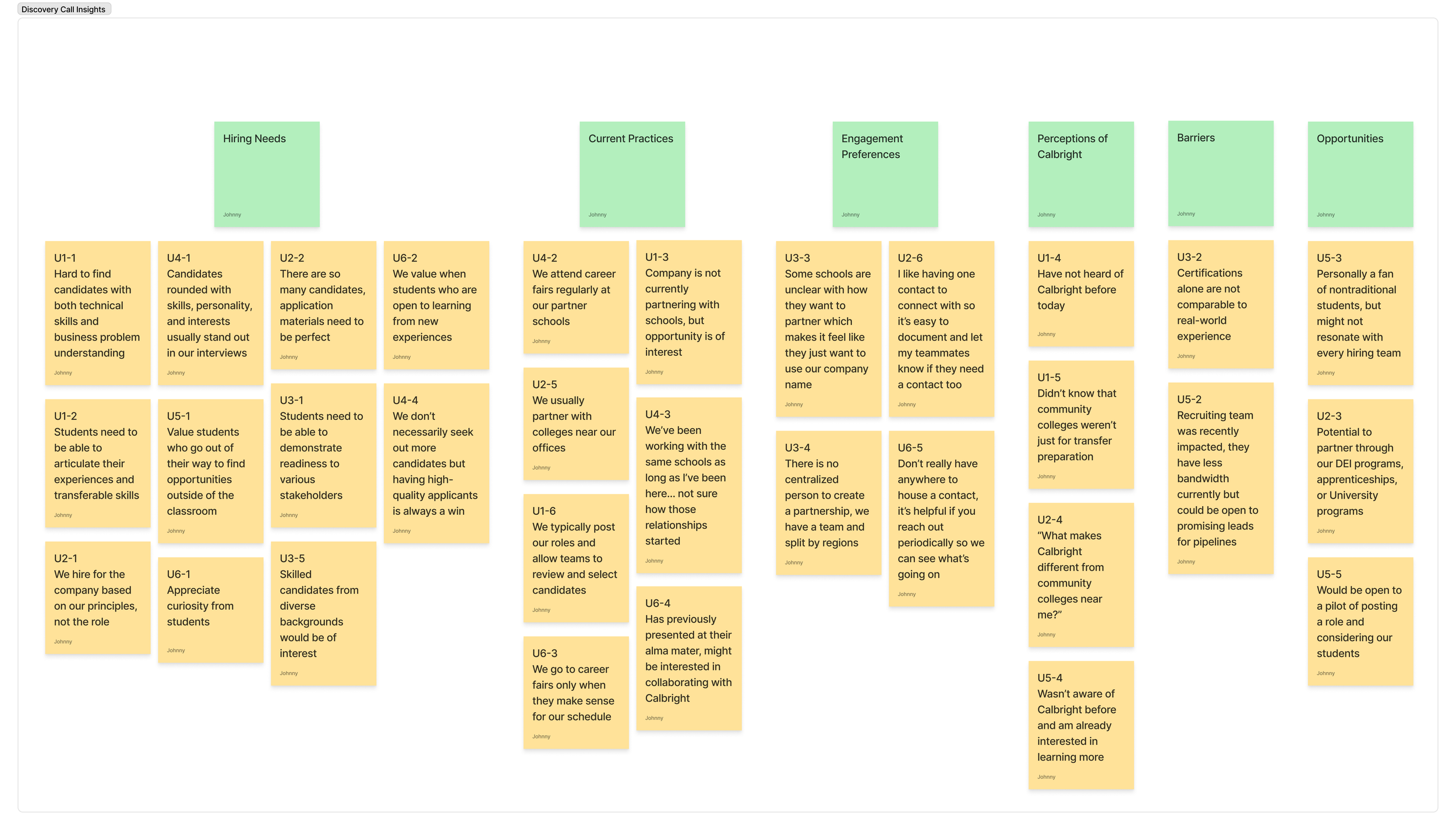
Key Learnings
Finding:
Employers prefer a smooth, predictable process when engaging with colleges
Insight:
Efficiency and clarity matter
Opportunity:
Simplify touchpoints and communication
Finding:
Many employers are unfamiliar with the college and its value
Insight:
Limited awareness of Calbright
Opportunity:
Increase visibility and clearly communicate unique offerings
Finding:
Employers are motivated by partnerships that reflect their values and access diverse talent
Insight:
Mission alignment drives engagement
Opportunity:
Prioritize mission-fit targeting
Finding:
Teammates lack a standardized way to manage employer relationships
Insight:
Inconsistent internal processes
Opportunity:
Develop workflows and tools to ensure consistency
These learnings directly informed the next phase, where I created personas, a journey map, and an employer flow to visualize and improve the employer experience.
Design
With insights and opportunities identified, I used the learnings to create design artifacts to clarify both the employer experience and internal processes. The artifacts aimed to: build a shared understanding, identify pain points, and set a foundation for a sustainable strategy.
As the lead, I guided collaboration with a consultant and my manager, co-creating and refining artifacts. I also facilitated critiques with teammates to ensure alignment with research insights and our goal of building a student-centered employer service model.
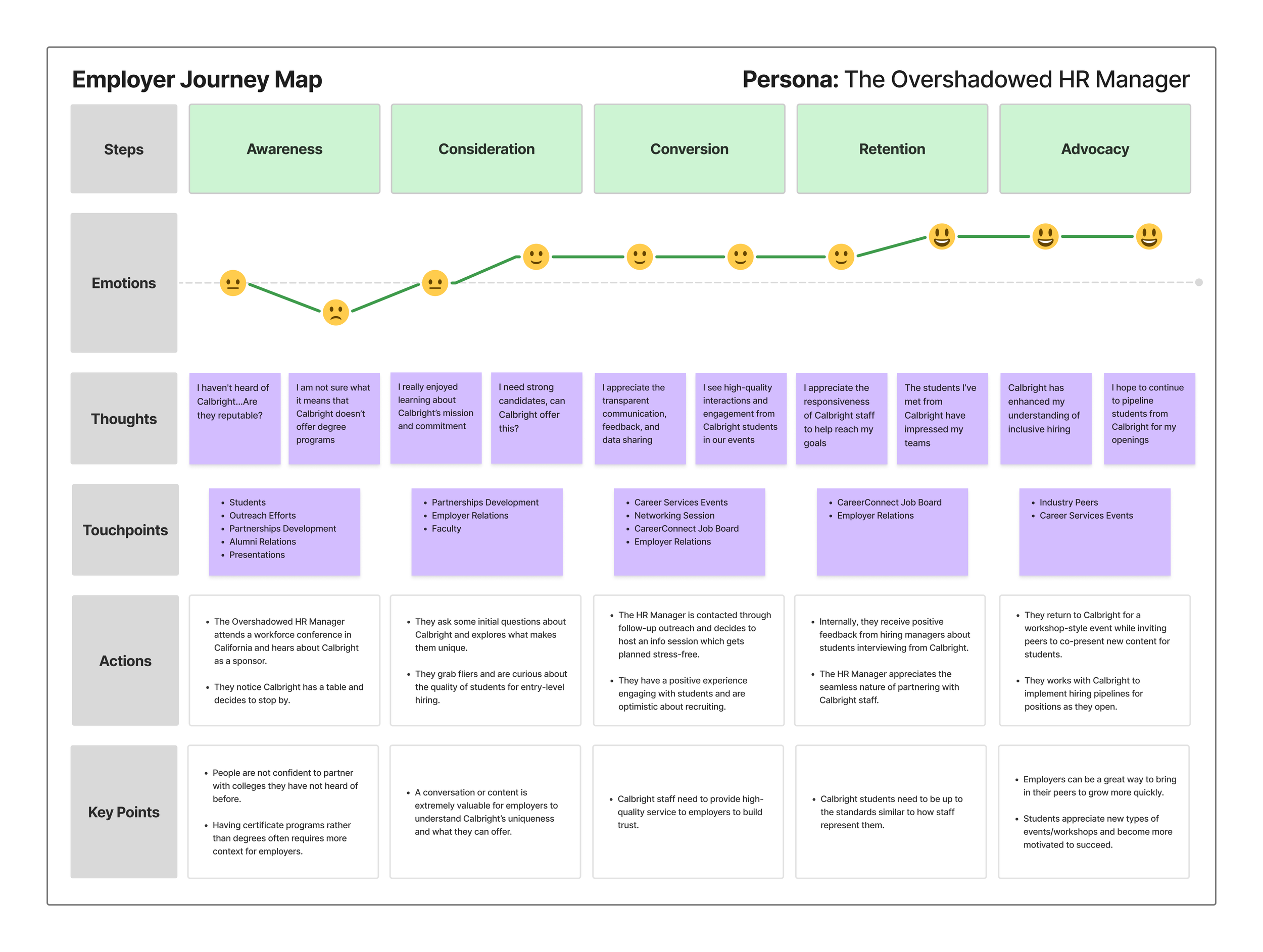
Experience Mapping
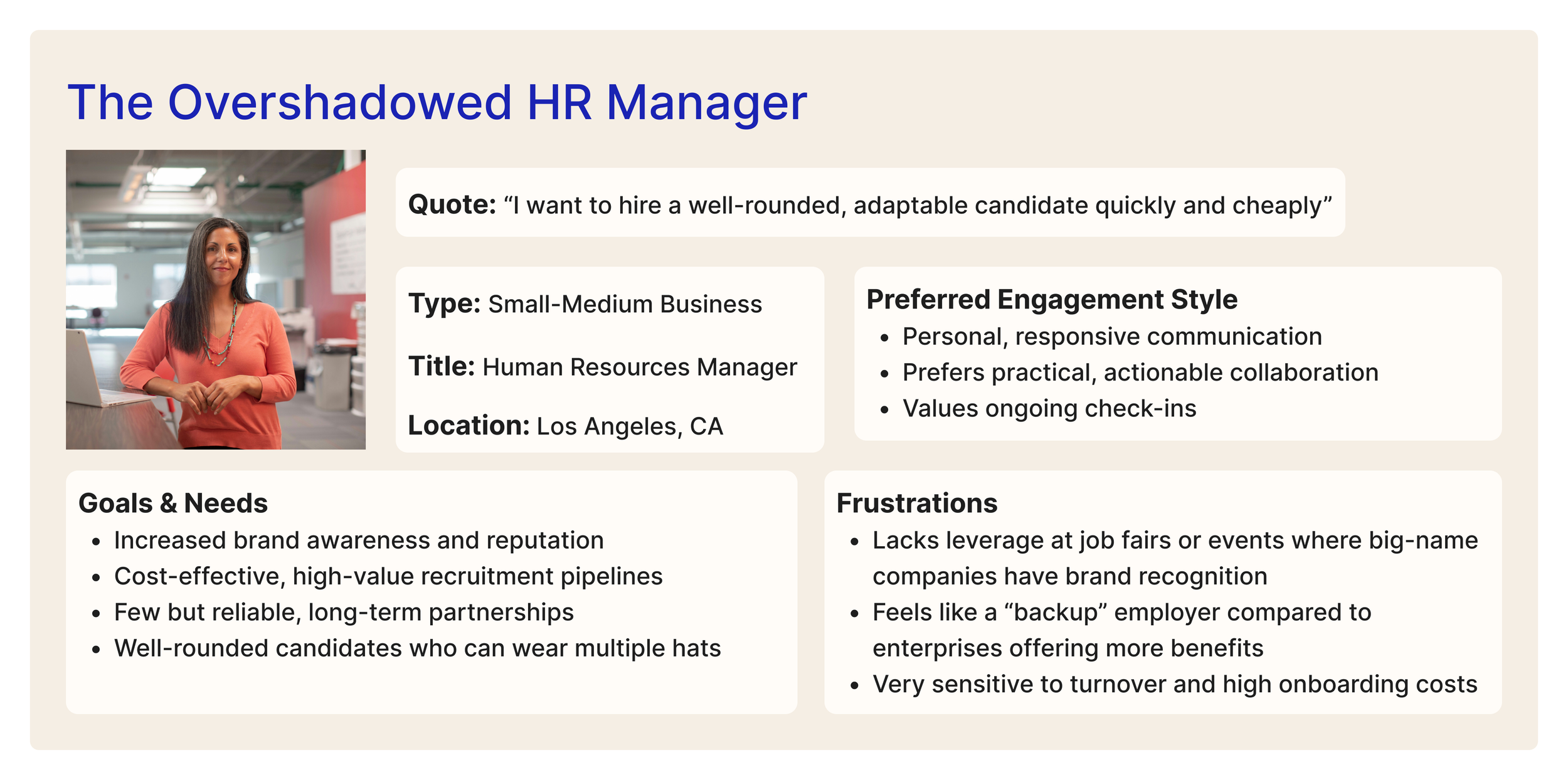
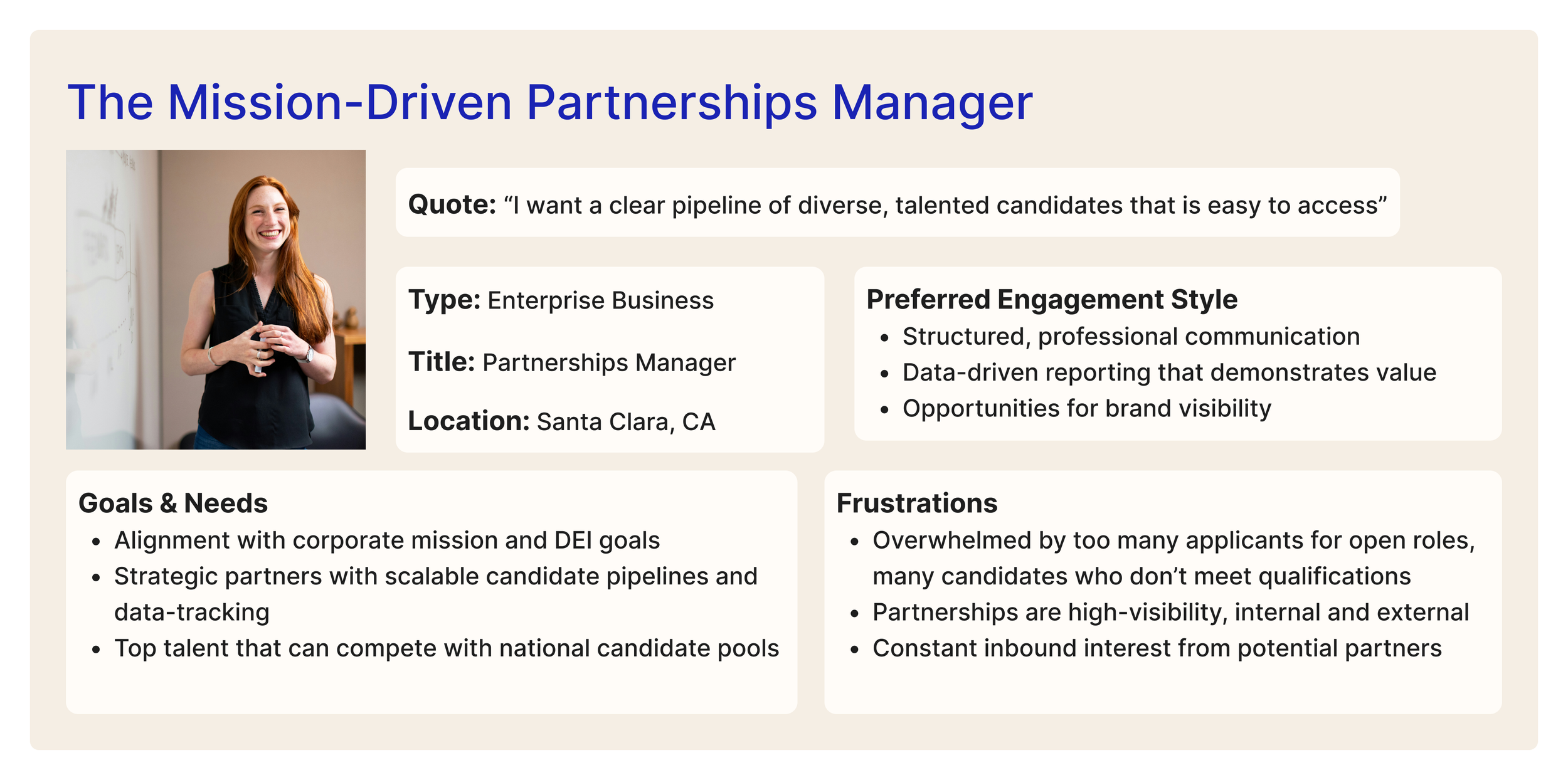
Personas
Developed three representative employer personas to capture motivations, goals, and frustrations:
Journey Map
Visualized the employer journey from awareness to partnership, summarizing key points and highlighting touchpoints.
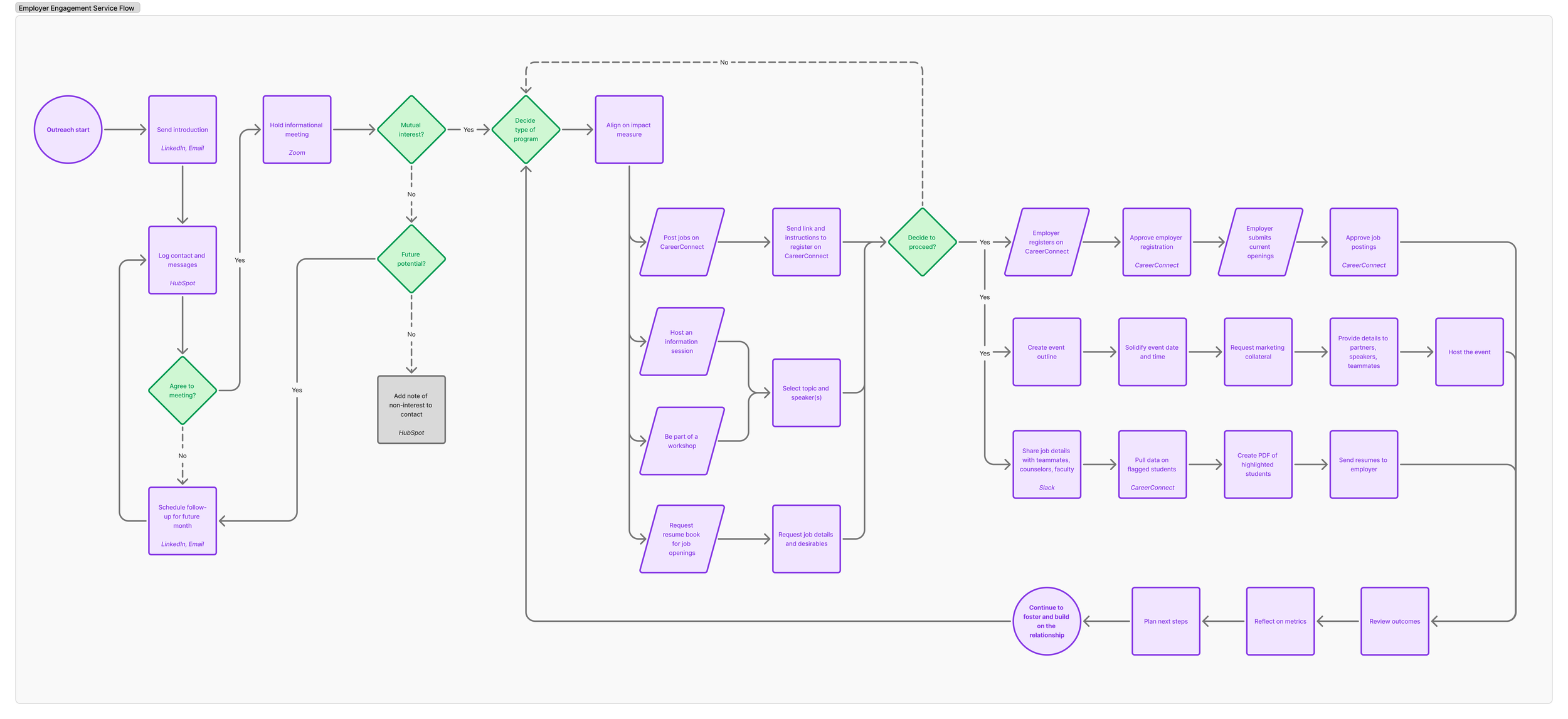
Employer Flow
Outlined an ideal step-by-step process for how employers engage with our team at Calbright from initial contact to sustained partnership.
Deliver
The project delivered a connected system of strategy, vision, and tooling. Together, the strategy, mission statement, and HubSpot implementation translated research insights into college-wide practice.
Outcomes
Employer Engagement & Funnel
Reached 280 employers through structured outreach, achieving a 10%+ response rate, which is strong for cold employer engagement in higher education.
50% of respondents progressed to two or more engagements, indicating sustained interest beyond initial contact.
Employer Strategy
Developed a comprehensive strategy document to define goals and methods for increasing employer relations outcomes
Solidifies employer engagement pillars for a scalable implementation of scope, priorities, and actionable
Experience & Service
Employer-facing events consistently delivered the highest attendance and engagement, with 90%+ satisfaction rates, validating them as high-impact service touchpoints.
These outcomes informed prioritization of employer experiences that delivered the greatest value both internally and externally.
Systems & Operations
Fully implemented HubSpot as the system of record across five cross-functional teams, enabling consistent tracking, handoffs, and shared visibility into employer relationships.
Defined scalable workflows and data standards, reducing fragmentation and supporting growth without adding operational overhead.
Measure and improve experience quality by seeking qualitative feedback at key employer touchpoints, using insights to refine messaging, onboarding, and events.
Optimize funnel conversion by tracking drop-off rates and time-to-value from outreach to repeat engagement, iterating on touchpoints where friction or uncertainty appears.
Strengthen long-term partnership value by measuring retention, re-engagement, and outcomes to prioritize highest-impact partnerships.
Support scalability by monitoring effort per employer, ensuring the service remains efficient and consistent as participation grows.
Next Steps
This project reinforced the importance of designing services as evolving systems rather than one-time solutions. By grounding decisions in research, aligning stakeholders around shared metrics, and iterating based on real-world use, I learned how service design can create clarity, trust, and scalability in complex organizational contexts.